

Enterprises have spent billions on AI over the last three years, and most still cannot point to a single end-to-end process that runs differently because of it. Pilots multiplied, copilots were switched on, model subscriptions were signed. The documents still get read by people, the spreadsheets still get filled by hand and the approval still waits for someone to reconcile three systems. The reason is not that the models are too small. The reason is architectural.
Five failures no model can fix
When we sit down with a bank, an insurer or a credit servicer, the same five problems appear regardless of which model vendor they have chosen.
- Fragmented intelligence. Knowledge lives in hundreds of applications that do not share a data model, so every AI initiative starts by rebuilding context from scratch.
- Agent-unready data. The most valuable information sits in contracts, statements, appraisals and emails, unstructured and without a semantic layer that a machine can reason over.
- Outsourced sovereignty. Models, embeddings and often the data itself run on infrastructure the institution does not control, in jurisdictions it cannot audit.
- Opaque decisions. A generated answer without a traceable source is not admissible in a credit committee, an audit or a regulator's inspection.
- Ten apps per task. People jump between a document viewer, a core system, a spreadsheet, a chat window and an email client to complete one step of one process.
A larger context window or a higher benchmark score changes none of these. A model that reads more text still reads it without knowing which entity a number belongs to, still runs where the vendor decides, still produces prose rather than a decision log.
What an operating system does instead
The analogy we use internally is deliberately mundane. macOS does not make your laptop faster; it makes thousands of applications share one file system, one security model and one user experience. An operating system for agentic AI does the same for an enterprise's intelligence.
- A semantic knowledge graph turns every document, record and process into an entity with relations and a source. Agents reason over it instead of guessing from raw text.
- One orchestration and governance layer models processes as ontologies, assigns permissions, logs every decision and inserts human review exactly where the risk sits.
- Model-agnostic serving routes each task to a domain-tuned small model, a large language model or a vision model, on premises when the data requires it.
- One standardised UX embeds agents into the applications people already use, rather than adding one more window.
What it looks like in production
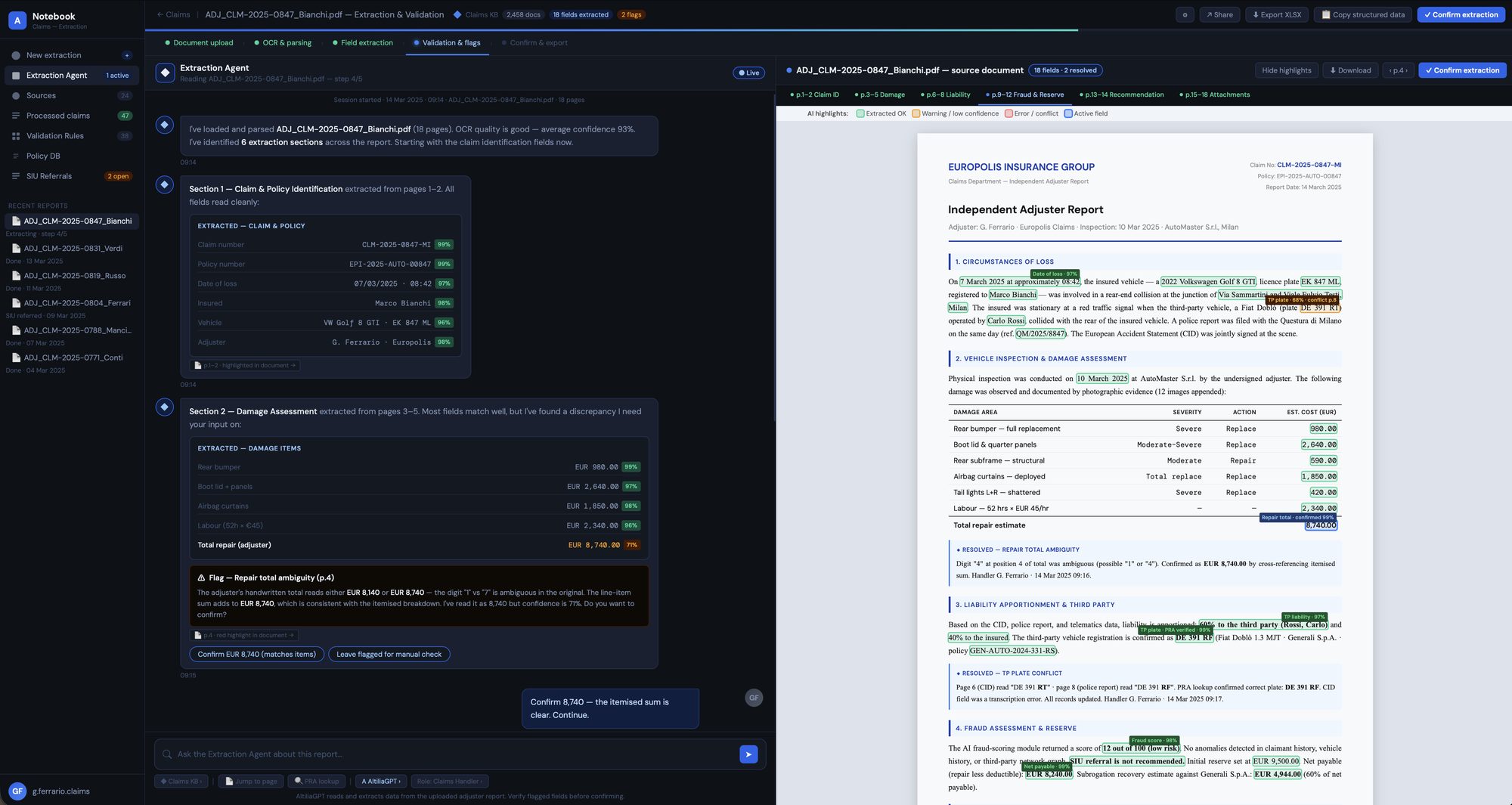
In lending, the difference is visible stage by stage. Onboarding agents read 27 document types and pre-fill 250 datapoints. Credit analysis agents validate financial statements against internal data before the file reaches the analyst. Regulatory agents answer 20,000 employees from the current rulebook rather than a stale intranet. Across the value chain, institutions measure 80% less manual effort, workflows ten times faster and a return on investment above 200%, with accuracy audited at 98.3% on 10,000 documents.
None of those numbers came from a bigger model. They came from a knowledge graph the agents could trust, an orchestration layer that made their work auditable, and deployment on infrastructure the institution controls.
“The winners of the next decade will not be the companies with the largest models. They will be the ones whose intelligence is organised, governed and sovereign.”
Where to start
Pick one process that is expensive, document-heavy and measurable. Map the documents it consumes and the systems it touches. Then ask any vendor three questions: where does the knowledge live once extracted, who can see what the agent decided and why, and where does the model run. If the answers are a vector index, a chat transcript and a hyperscaler region, you are buying a feature, not an architecture.
Key takeaways
- Model size does not address fragmentation, sovereignty, opacity or context switching.
- An OS for agentic AI adds a semantic layer, a governance layer and model-agnostic, sovereign serving.
- Measured results in production come from architecture: 98.3% audited accuracy, 80% less manual effort, ROI above 200%.
Curious how this would work on your documents?
Related posts
More from the same conversation. All articles
Gartner cites Altilia in the 2026 Magic Quadrant for IDP. Here is how the platform maps to the market it describes.
Four use cases, four mandatory features, sixteen optional ones. Altilia covers them on a knowledge graph, under sovereign deployment, with agents already in production.
Read more →
Symbolic AI and LLMs were never rivals. The ontology is where they meet.
Language models are fluent and ungrounded; symbolic systems are rigorous and empty. Altilia lets agents create and populate ontologies, then reason over facts grounded in them, not just extract data or chat over documents.
Read more →
Semantic layers become critical infrastructure by 2030. Most enterprises have none.
Analysts expect universal semantic layers within the decade. Altilia has been building one, on ten years of research at the National Research Council, for the institutions that need it first.
Read more →Send us a message.
Start envisioning the platform tailored for your company. An AI consultant will answer within one business day.