One AI-native operating layer for people, agents and apps.
Altilia is the operating system and the semantic data layer for agentic AI in industry: a sovereign, semantic, orchestrated platform on which intelligent enterprises run, automate and evolve.
Six pillars. One sovereign enterprise OS.
The architecture analysts call critical infrastructure by 2030, in production today at Tier-1 European institutions.
Semantic knowledge graphs
Scattered data, documents and processes organised into an ontology-based semantic layer that centralises business-process data for every AI application. Ontologies are created and populated directly by agents, so language models reason over facts rather than text. The foundational layer Gartner calls critical infrastructure by 2030, in production today.
GraphRAG and traversal queries
Agents navigate semantic relationships across the knowledge graph and follow entity links and ontological paths, returning precise, context-rich and fully traceable answers with the reasoning depth enterprise decisions require.
Governable agent orchestration
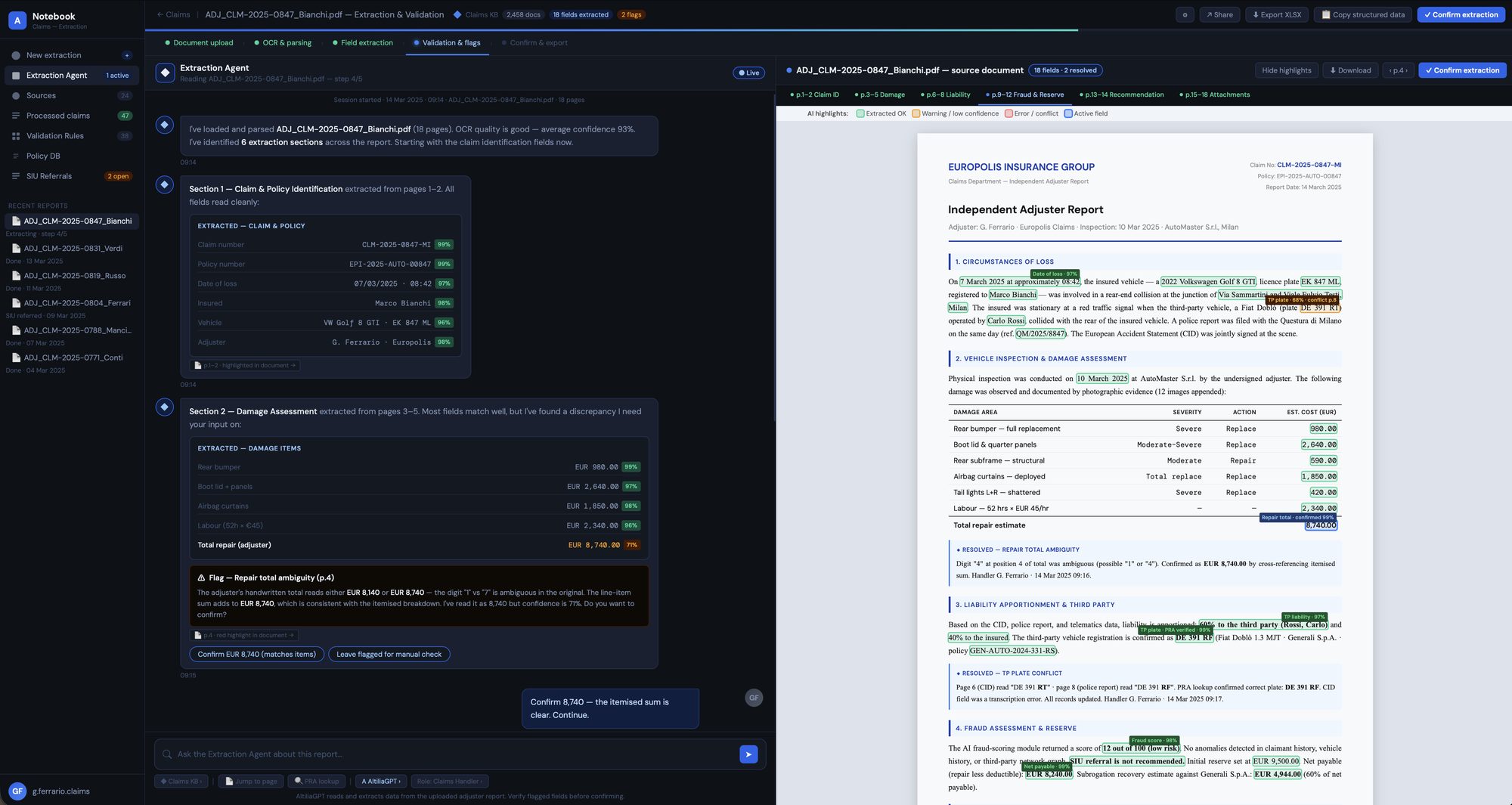
Users work alongside deterministic, context-aware agents that automate workflows and support decisions, with governance, auditability and zero-trust security built in rather than bolted on.
Ontology-driven workflows
Business processes modelled as ontologies give agents a formal understanding of tasks, roles, rules and dependencies. Agents reason over process intent, adapt to exceptions and orchestrate end-to-end workflows.
Domain-tuned language models
Small and large models fine-tuned on enterprise data, served on-premises when required. No dependency on a single AI vendor; models optimised for the accuracy, latency and compliance profile of each industry.
Deployment sovereignty
SaaS for speed, private cloud for compliance, on-premises or hybrid for maximum data and model sovereignty. EU AI Act compliant by design, with no vendor lock-in and governance over every inference.
From any source to governed action.
Flexible, scalable, enterprise-grade architecture. Agents learn, adapt and improve through human feedback, from simple workflows to complex deployments.
Three user layers. Infinite apps.
The same OS serves the back office, the experts and the line of business, through interfaces designed for each.
For back-office users
Altilia Robots
Agentic process automation at scale. Robots automate end-to-end processes for any data type and format, producing structured data usable across enterprise systems.
For expert users
Altilia Skills
Every employee can build agents that integrate with company systems and deliver context-specific actions and insights, in the no-code and low-code environment.
For the line of business
Altilia Notebook
Agentic conversational assistants. Create and use agents in natural language to interpret documents, analyse data and work with apps in one unified UX.
Beyond IDP, RPA and BPA.
Altilia does not replace a tool. It replaces a generation of enterprise automation: rule-based extraction, brittle UI scripts and static workflow maps.
Instead of IDP
Semantic IDP with agents
Understands documents and data through a knowledge graph. Extracts, relates and acts, routing outputs into live workflows with zero manual rekeying.
Instead of RPA
Agentic process automation
Agents adapt to UI and API changes, handle exceptions and reason over unstructured inputs. No brittle scripts; orchestration that learns.
Instead of BPA
Agentic business orchestration
Dynamic, AI-driven flows that handle edge cases, apply semantic rules and make governed decisions, replacing static process maps.
| Capability | Altilia | US hyperscalers | IDP platforms | RPA / BPA platforms | Point-solution AI tools |
|---|---|---|---|---|---|
| Semantic knowledge graph | ✓ | ✗ | ✗ | ✗ | ✗ |
| GraphRAG and traversal queries | ✓ | PartialVector search only; no ontological reasoning | ✗ | ✗ | ✗ |
| Document understanding (IDP) | ✓ | PartialGeneric extraction; no cross-document semantic linking | ✓ | PartialFormat-specific; no semantic linking | ✗ |
| End-to-end agentic orchestration | ✓ | PartialCopilots only; no end-to-end process execution | ✗ | PartialRule-based only; no AI reasoning | PartialSingle-purpose; no workflow integration |
| Process automation (RPA/BPA) | ✓ | PartialLow-code tools; no semantic process reasoning | ✗ | ✓ | PartialTask-specific; no multi-step orchestration |
| On-premises LLM deployment | ✓ | ✗ | ✗ | ✗ | PartialOpen-source models only; no enterprise governance |
| AI sovereign by design | ✓ | ✗ | ✗ | ✗ | ✗ |
| Deterministic, auditable outputs | ✓ | ✗ | PartialConfidence scores only; no bounded knowledge scope | ✗ | ✗ |
Deploy your way: SaaS, private cloud or on-premises.
Choose the model that fits your security posture. The platform includes AIOps, model lifecycle maintenance and dynamic resource scaling, so performance holds as AI adoption grows.
- Flexible deploymentSaaS, private cloud, on-premises or hybrid from the same codebase.
- AI lifecycle maintenanceMonitor and maintain up-to-date models throughout their lifecycle.
- Dynamic resource scalingAutomated adjustments based on performance and workload.
- Data ownership and IPYou keep ownership and control of models and agents developed on the platform.

Governable by a zero-trust approach. Open by design.
Every agent runs under least-privilege permissions and leaves a decision log. Every model, ontology and agent stays yours, and the OS federates with the AI platforms you already run.
No agent trusted by default
Each agent is identified, scoped to the data, tools and systems its process needs, and authorised on every call. Permissions, model versions and human review points are enforced by the OS, and every decision is logged with its sources for audit.
Standard interfaces in and out
Models are served behind OpenAI-compatible endpoints, agents work with any LangChain-compatible model, and connectors, REST APIs and MCP servers link the OS to CRM, ERP, ECM and core systems in both directions.
Runs alongside the platforms you have
The OS federates with hyperscaler, open-source and in-house AI platforms: route a task to their models, expose Altilia agents to their orchestrators, share the knowledge graph under your permissions. Ontologies, datasets, weights and agents remain your intellectual property and leave with you.